Our Obligatory Post About The Odyssey (and what the epic might teach us about storytelling-for-advocacy)
Yep, we're doing it.
Everyone’s weighing in on Christopher Nolan's The Odyssey — the box office numbers, the armor discourse, the modern-English dialogue debates.
Given that The Odyssey is one of the foundational narratives of Western culture, and our work at Living Proof Advocacy sits squarely in the world of storytelling (storytelling-for-advocacy, not myth-making, but storytelling all the same) it seems only fair we ask what this cultural moment and this story have to say about modern-day storytelling for advocacy.
So here are three insights from The Odyssey for advocates sharing their stories from lived experience to make a difference in the modern world.
ONE: When you speak your story aloud, you draw on ancient roots.
Long before The Odyssey was written or filmed — long before it was translated by Robert Fagles or Emily Wilson or was a $200 million IMAX production — it was a person, standing in front of other people, telling a story out loud. There was no gap between the storyteller and the story; together, they were the text. They happened at the same time, in the same body.
The Odyssey originated in the immediacy of the oral tradition — composed and performed by bards — long before anyone wrote it down. In the centuries that followed, the gap between story and storyteller widened: first when the poem was fixed in writing, then again through manuscript copying, and eventually through the printing press, all making it possible to encounter the story with no storyteller in the room at all.
As an advocate speaking out loud the story of your own lived experience, you collapse that gap back down. You are both story and storyteller, both message and messenger.
You're returning storytelling to its original power: embodiment.
TWO: The Hero's Journey gets all the credit. Your Advocate's Journey deserves some too.
The Odyssey is basically the source code for the Hero's Journey, the story framework Joseph Campbell identified decades later:
Depart. Descend into trial. Return, transformed.
It's a classic story structure. It's also not the only one worth living — or the one most of us actually live.
Over the years, thanks to the thousands of advocates we've met or supported, we've mapped something we call the Path to Advocacy — a parallel arc for the person who takes a private experience and turns it into public advocacy.
Process. Decide. Define. Develop. (Repeat)
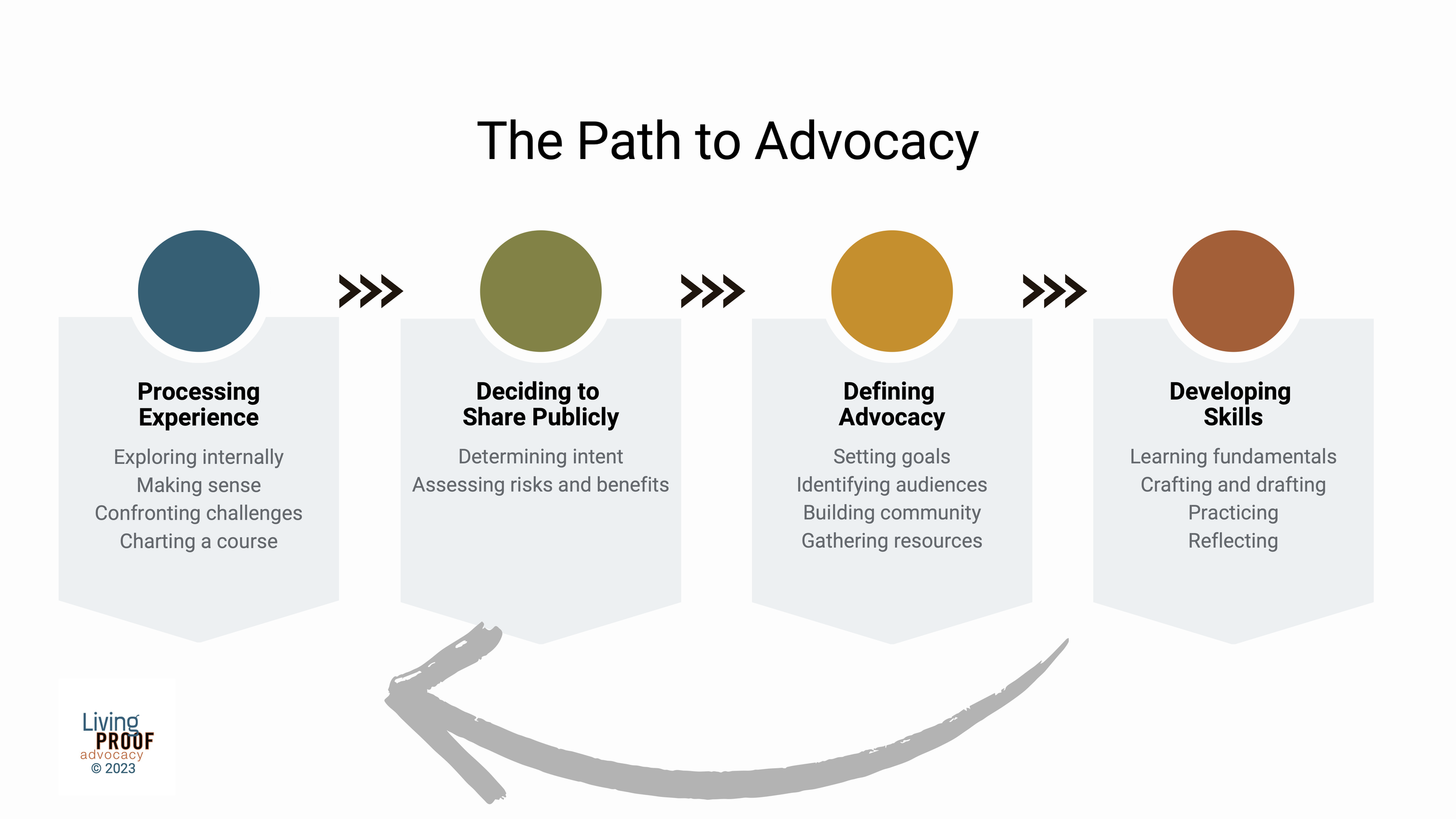
The Advocate’s Journey along the path is one that moves from private reflection to public action, from sense-making to change-making. And because life keeps moving, the journey often folds back on itself.
The Advocate’s Journey is no less significant than the Hero’s Journey — demanding its own courage, its own reckoning with fear and obstacles, its own acquiring of new skills and powers.
THREE: Where your story starts is a choice — and it's yours to make.
Here's a detail that's easy to forget in the face of Nolan's movie, which centers Odysseus from its very first scene, hiding inside a giant wooden horse, tricking the Trojans into bringing it through their city gates.
The classic text does something very different. Homer's poem doesn't open with Odysseus at all. It opens with the gods arguing about him, and then with his son, Telemachus, alone in a house full of suitors, trying to hold a life together in his father's absence. Four full books go by before we actually meet Odysseus as a character — and when we finally do, in Book 5, he's not outwitting a cyclops or lashed to a mast resisting sirens. He's sitting on a beach, weeping, having just turned down a goddess's offer of immortality because he'd rather go home than live forever as someone other than himself.
Homer could have opened with the Trojan War, or Odysseus’ decade of legendary cunning — and framed him for us as wily, indomitable, a man built for battle. Homer chose to frame him instead in grief and homesickness — because that's the truth he wanted us to carry into everything that follows.
What does that have to do with you as an advocate? When you share your own personal stories, a similar choice needs to be made: how do you frame yourself? How do you want the audience to see and know you? Advocacy storytelling isn’t just about deciding what to include — it’s about where to start your story and how to let people see you inside it. As the author of your own story, you get to decide how it's told. Rarely does that mean starting at the beginning and marching through, year by year, to now. More often it means choosing scenes, and trusting them to carry the weight of what you want people to understand about you and your experience.
One more thing before we let Homer go.
In Homer’s poem, Odysseus doesn't just live his story — at a crucial point, he tells it, out loud, to a room full of strangers, as the price of getting help returning home. He washes up shipwrecked and nameless on the island of the Phaeacians, and for a while, no one there knows who he is. It's only at a banquet, moved to tears by a bard's song about the war he survived, that he finally reveals himself and narrates the whole of his journey in his own voice — the Cyclops, Circe, the Sirens, the underworld, all of it. Only after hearing it do the Phaeacians commit their ships to sending him home.
Your advocacy works the same way. The story only does its job once you've decided to say it out loud, to people who can act on it.
Want to build your own version of the Advocate’s Journey — and learn to tell it in a way that actually moves people to action? Explore our online course and our remote coaching options.